01 / Parking
Parking lot and garage washing
Oil drips, tire marks and grime washed from surface lots, garage decks and stairwells.
View details
Guide
Pressure washing is priced by the square foot, and the rate moves with the surface, the city and how often you wash. Here’s the whole picture.
Commercial pressure washing is priced per square foot of surface cleaned on each visit, whether that surface is a wall, a garage deck or the walkway in front of a store. Across the area Raincrest serves, 2026 market rates put most jobs between $0.17 and $0.47 a square foot. Wide, lightly soiled surfaces start near $0.11, and tall, stained or delicate work climbs to about $1.00.
Those ranges are for setting a budget. Your own number comes from an on-site walkthrough and the written quote that follows it, and recurring routes are often written as a fixed total per visit.
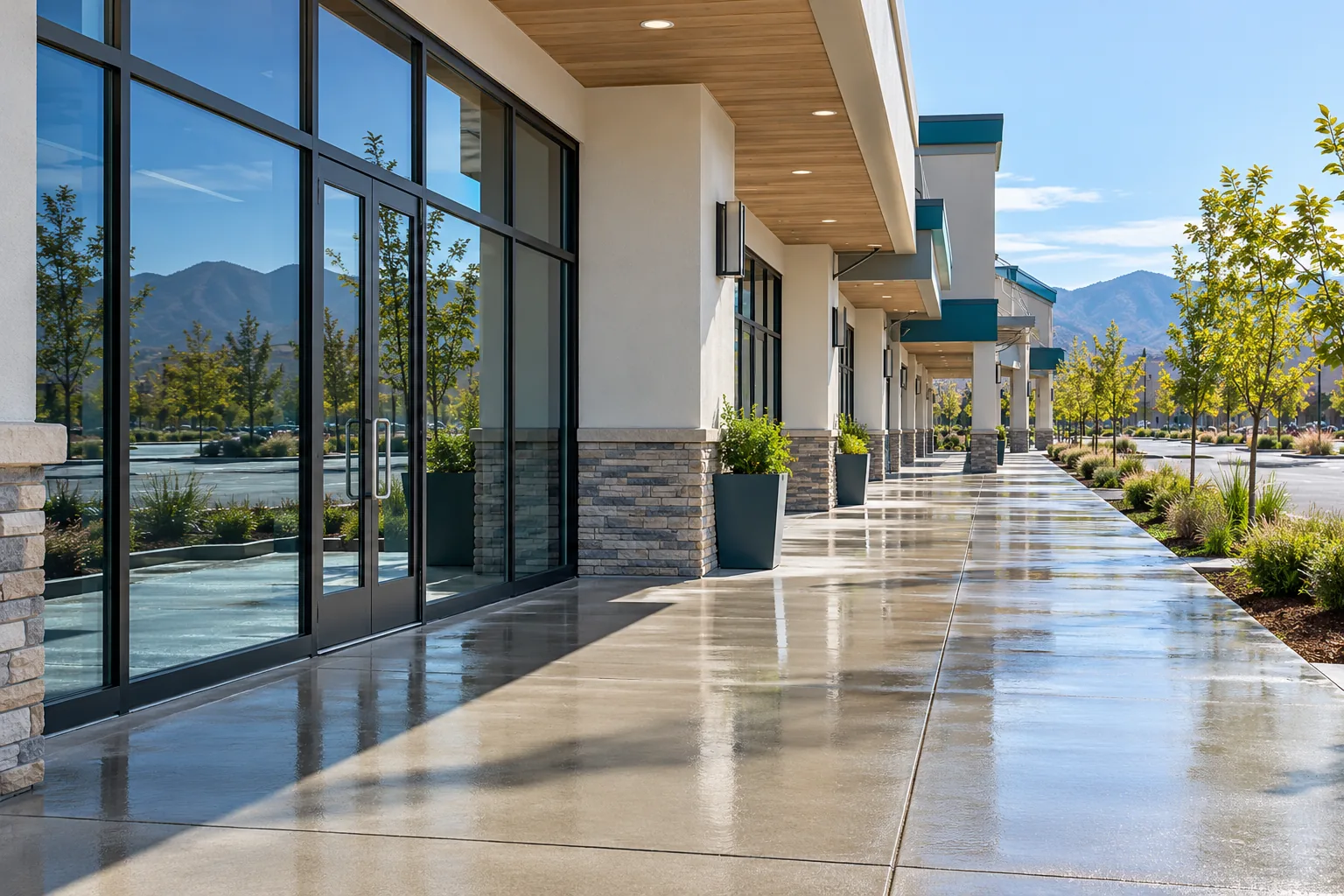
Big open surfaces sit at the bottom of the scale. A garage deck, surface lot or truck court lets the crew keep moving instead of resetting, so it usually prices at $0.11 to $0.17 a foot even when the total is large. Storefront walks and entries land around $0.18 to $0.35, since gum and drink stains by each door take extra time. Dock aprons and truck wells run $0.20 to $0.47 with the oil they carry, and most building walls fall between $0.17 and $0.35, rising with height and with finishes that need a lighter touch. Dumpster pads, restaurant back doors, graffiti and dense gum sit at the top, from about $0.35 to $1.00, because grease and spot work slow every foot.
Open plazas, courtyards and public sidewalks washed through our concrete, sidewalk and plaza cleaning service are priced on the measured slab, how deep the staining runs, the steps, curbs and edges, and how often the area is washed.
Labor is the biggest part of every job, so the rate follows local labor costs. Reno sits at the bottom, with most work there priced from $0.17 to $0.39 a square foot. Sacramento, Stockton and Elk Grove usually run $0.18 to $0.42, with Roseville at the same band and Folsom a cent higher at the top for its older brick and decorative paving. Sparks tracks Reno. San Francisco and Mountain View carry the highest labor costs in the region, with a typical band of $0.20 to $0.47, and Sunnyvale, Palo Alto and Santa Clara sit close behind.
Put the Santa Rosa plaza from above into other cities and the visit changes. Priced near $0.18 a foot in Reno, the same 6,000 square feet comes to $1,080. Near $0.24 in Mountain View, it reaches $1,440. Every city page lists its own local band, from Reno to San Francisco.
Within a city, the property itself does most of the work on price. Area comes first, then condition: concrete left alone for a year needs a heavier first visit than a slab on a steady schedule. Problem spots such as oil, flattened gum, grease and tags add passes. Height, lifts and gentle finishes slow wall work, and steps, curbs and edges take longer per foot than open slab.
Timing and setup count too. Overnight and weekend washing, sections kept open for cars and shoppers, and covering nearby storm drains before the first pass all go into the plan. Frequency pulls the other way, since areas that come around often stay lighter on every visit.
Two bids only compare when they cover the same surfaces. Check that each one lists the same areas and roughly the same measured square footage, then compare the rate per foot as well as the visit total. Look for the problem spots called out on their own lines, the frequency for each area and the timing of the work, so a lower number isn’t hiding a smaller job.
Our guide to what a commercial pressure washing quote includes walks through each line of a Raincrest quote, which makes this check quick.
A few useful answers
Open decks let the crew keep moving across the slab, so less of the night goes to setup and the rate per foot stays toward the low end.
Both appear. The rate per foot sets the number, and recurring work is usually written as a fixed total for each visit.
Labor. It is the largest part of every wash, and it costs more on the Peninsula than in northern Nevada.
Yes. Surfaces on a steady schedule build up less between visits, so each wash goes faster than a heavy first clean.
Book a walkthrough. We measure the surfaces with you, note the problem spots and send a written quote.
Resources
Services
The worked examples above come from these services.
01 / Parking
Oil drips, tire marks and grime washed from surface lots, garage decks and stairwells.
View details02 / Storefronts
Entrances, walkways, awnings and the concrete in front of the door, clean before you open.
View details03 / Facades
Stucco, block, brick, siding and trim washed clean of dust, grime and streaks.
View details