01 / Restaurants
Restaurant and drive-thru exterior cleaning
Drive-thru lanes, patios, entries and grease-stained concrete washed after close.
View details
Guide
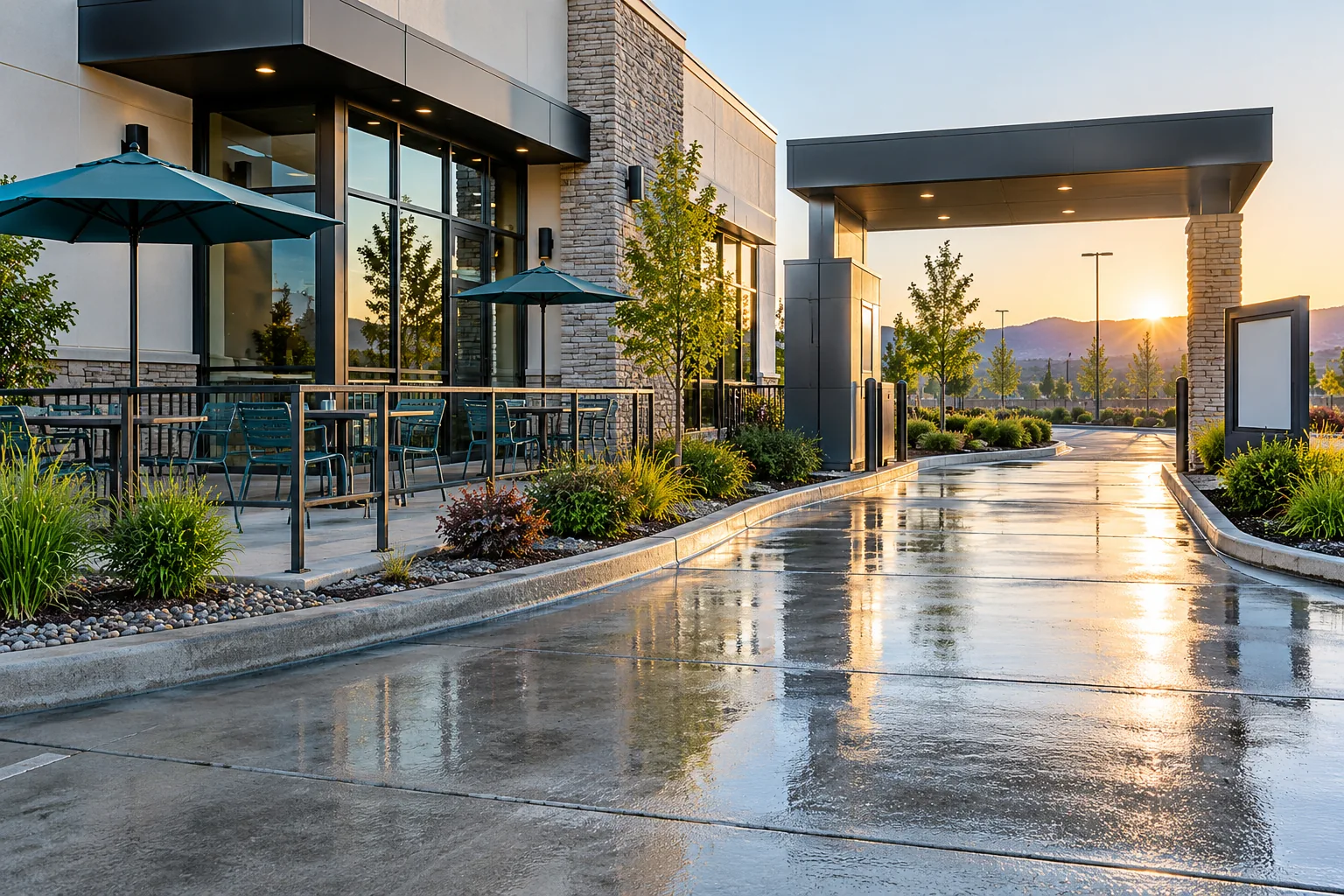
For many guests, the drive-thru lane is the whole visit. Here’s what builds up along it and how it gets washed without costing you a single order.
Plenty of customers never walk through the front door. They pull in, order at the board, pay and pick up at the window, and everything they know about the place comes from that loop of concrete and the walls beside it. A dark, sticky lane tells them something about the kitchen, fair or not.
The lane also takes more abuse than almost any other surface on the property. Cars idle in the same tracks all day, and food, drinks and napkins end up on the ground at every stop along the way.
That makes the lane worth planning on its own instead of folding it into a general lot wash. It has its own stains, its own tight timing and its own stops, and each one needs a slightly different touch.
Follow a car through from the entry. In the stacking area, engines idle and drips land in a steady line down the center of the lane. At the menu board, drivers lean out to talk, and wrappers and spilled drinks gather along the curb and around the base of the speaker post.
The pickup window sees the heaviest wear. Every car stops in nearly the same spot, so oil, tire grime and spilled soda stack up right under the window. The wall below the sill catches splashes, and the concrete near the exit collects whatever slips out of a bag on the way back to the street.
Cooking vents add their own layer. Walls near the window can carry a dull, tacky film that grabs dust and makes fresh paint look tired within a season.
These two spots deserve their own attention on wash night. Around the menu board, the crew washes the curbs, the concrete pad, the post and the lower frame, with a careful touch near the board face and the speaker. At the pickup window, the wall, the area under the sill and the concrete below are washed until the stains under the stopping point come up.
Oil in the stacking lane gets extra passes, the same way stall stains do in a parking lot. Our guide on oil stains on parking lots explains what a wash lifts and what it lightens.
Curbs along the lane matter more than they seem. Tires scuff them, and the seam where curb meets concrete traps litter and grit. Washing that seam cleanly makes the whole lane look sharper when headlights sweep across it.
A drive-thru can’t close for a morning to be washed, so the work fits into the gap between the last order and the first prep shift. At late-night locations that gap is short, so the crew plans the order of work carefully: the lane and window first, left clean and drying, then the patio and the back of the house.
If you close late and reopen early, the job can be split across two nights, with the lane and window on one and the patio, walls and enclosure on the other. Operators with several locations can put every site on one shared calendar.
Tell us at the walkthrough when your last order goes out and when the breakfast crew arrives. That window shapes the plan written into the quote.
Drive-thru lanes often run close to the street and to curb inlets. Before the first pass, the storm drains nearest the lane are covered before any water reaches them. Our guide to where the wash water goes walks through that step in more detail.
Grease bins, the back door and the dumpster pad are often washed on the same visit, since on many sites they sit a few steps from the window. Our restaurant exterior checklist covers those spots and the rest of the property.
Washing them together saves a separate trip and leaves the whole site ready for service at once.
Lane traffic sets the schedule. A busy breakfast and lunch location stains its stacking lane far faster than a quieter site, and summer heat in the inland valleys bakes spills in quickly. Keep the lane and window on a tighter schedule than the walls and the rest of the lot.
Between washes, a staff sweep of the lane at close and a quick pickup of cups and wrappers by the board keep it from sliding. See restaurant and drive-thru exterior cleaning for everything Raincrest washes at a restaurant.
Watch for the signs it’s due: a dark band forming under the window, a tacky feel underfoot at the order point, or cups and wrappers caught along the curb. When those show up before the next visit, the date can come forward.
A few useful answers
Yes. The lane is washed after your last order or before the first prep shift, and it’s finished first so it’s ready when the window opens.
The curbs, concrete pad, post and lower frame are washed, with a lighter touch near the board face and the speaker.
The concrete right under the pickup window, since every car stops in nearly the same spot and drips, grime and spills land there.
Yes. The lane and window can go on one night and the patio and back of house on another.
Services
The lane is usually washed with the rest of the restaurant exterior.
01 / Restaurants
Drive-thru lanes, patios, entries and grease-stained concrete washed after close.
View details02 / Parking
Oil drips, tire marks and grime washed from surface lots, garage decks and stairwells.
View details