01 / Parking
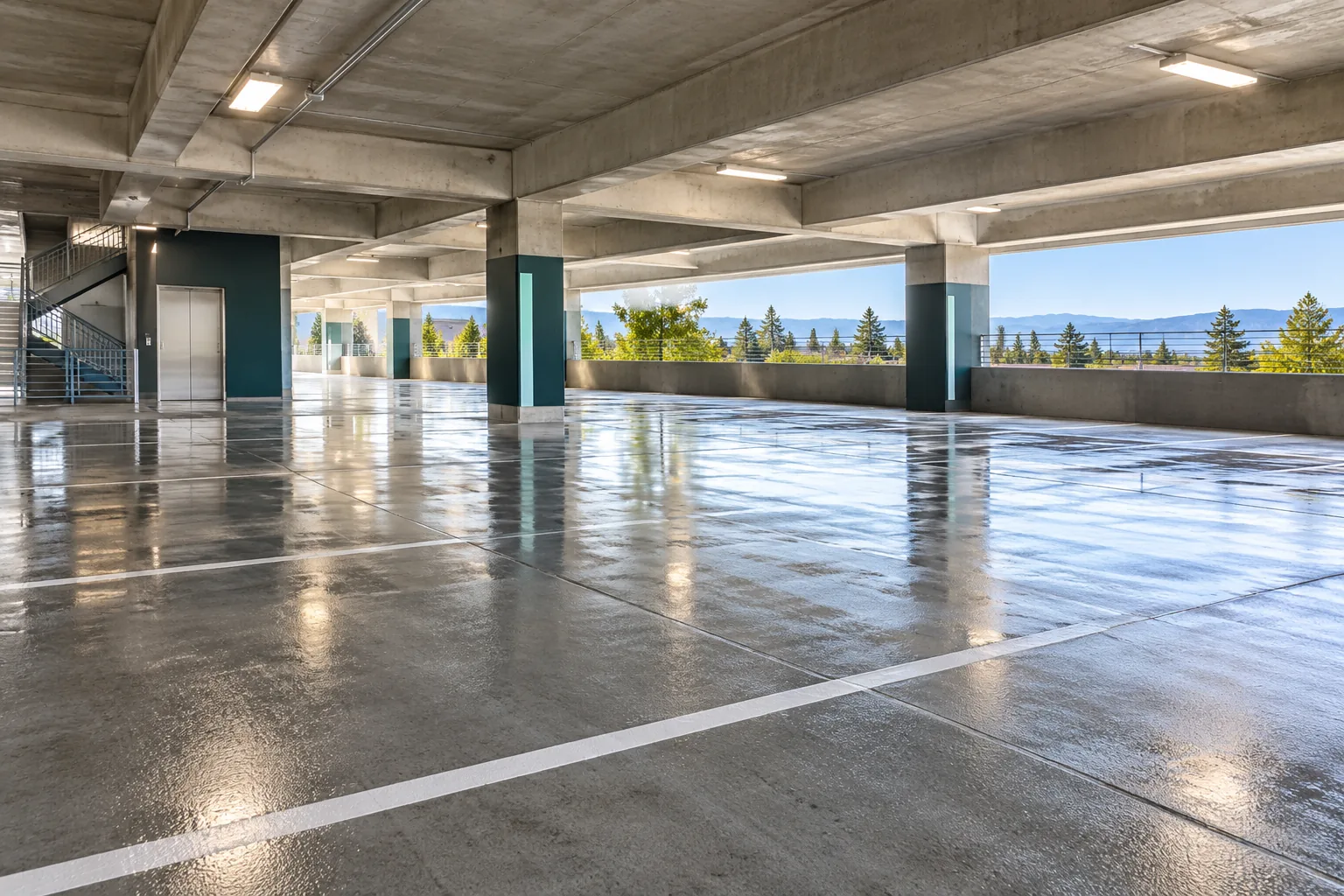
Parking lot and garage washing
Oil drips, tire marks and grime washed from surface lots, garage decks and stairwells.
View details
Guide
Every lot has a dark oval where the same cars sit each day. Here’s how those drips build up, what a wash takes out and how to keep the stalls from going dark again.
Walk a parking lot at dawn and the pattern is easy to read. The drive aisles stay fairly light, while a dark oval sits in the middle of every stall near the entrance. Those ovals come from cars that park in the same spot day after day, each one leaving a few drops of oil, coolant or brake fluid behind.
Concrete and asphalt both soak those drops up. Fresh oil darkens the surface, then tire grit and dust settle into it, and the stain spreads a little wider with every car. After a summer of sun, the oil bakes further into the pores of the slab, and a spot that once wiped up becomes part of the pavement.
The busiest stalls show it first. Spaces by the front door, reserved spots for managers and tenants, and the stalls closest to a cafe or a gym go dark long before the far rows do.
A pressure wash takes off everything sitting on top of the stain: the grit, the tire dust and the sticky film that turns a small drip into a black blotch. Fresh drips that haven’t had time to soak in usually come up with it. On a lot that has gone a while between washes, that alone changes how the whole surface looks from the street.
Raincrest crews give the oil spots at busy stalls extra passes instead of treating them like open aisle. Each stall is worked until the stain stops giving anything up, then the concrete around it is washed so the stall blends with its neighbors rather than standing out as a pale square.
Old stains are a different story. Oil that has sat in the slab through several seasons has moved below the surface, and a wash reaches what is on top. Those stains come up noticeably lighter, often fading from a black oval to a soft shadow, but a faint outline can remain in the concrete.
Setting that expectation early keeps everyone on the same page. At the walkthrough we point out which stains look fresh and which look old, so you know which stalls will come back close to new and which will look much better without vanishing. The goal is an even, cared-for lot where the worst stalls no longer pull the eye.
The best day to deal with a drip is the day it lands. Ask maintenance staff to glance at the busiest stalls on their rounds. A fresh puddle can be covered with an absorbent, left to soak and swept up, which keeps it from spreading under the next set of tires.
A steady leaker, such as a delivery van that parks in the same loading stall every morning, is worth a quiet word with the tenant or a drip pan under the engine. Small steps like these slow the buildup between visits, so each wash starts from a lighter surface.
Think about the wash water, too. Before any washing starts, the storm drains near the work are covered so wash water stays out of them. Our guide to where pressure washing runoff goes explains that step.
The schedule comes from how hard the lot works. A retail center with a full lot all day collects drips far faster than an office park that empties each evening. Restaurants see oil wherever cars idle in line, and our guide to drive-thru lane cleaning covers that stretch of pavement.
Split the lot in two: the stalls nearest the doors and the entry lanes come around often, and the far rows and perimeter less often. Washing before the first fall storms is a smart habit, because rain lifts loose oil off the surface and smears it across the aisles in slick, rainbow sheens.
The schedule for each area is set during the on-site walkthrough and written into the quote. Once you see how quickly the stalls come back, it can tighten or loosen.
Lots get washed while they are empty: overnight, early in the morning or on a weekend. The crew cones off one section, washes it and reopens it before moving on, so the lot never fully shuts. A car left in a section is washed around, and that stall gets picked up on a later pass.
At shopping centers, the parking field often shares a visit with the walkways and plazas, and our guide to shopping center common-area cleaning shows how it all fits into one early morning. See parking lot and garage washing for the full service.
A few useful answers
Old stains come up noticeably lighter, and fresh drips usually lift right off. Oil that has soaked into the slab over several seasons can leave a faint outline, and we point those stalls out at the walkthrough.
Cover it with an absorbent, let it soak, then sweep it up. Catching it the same day keeps it from spreading and baking in.
Yes. Sections close one at a time behind cones and reopen before the next one closes, so parking stays available.
The ones nearest the entrances, reserved spaces, loading stalls and any drive-thru stacking lane, since the same cars stop there every day.
Services
Oil spots get their extra passes as part of lot and garage washing.
01 / Parking
Oil drips, tire marks and grime washed from surface lots, garage decks and stairwells.
View details02 / Concrete
Sidewalks, walkways, plazas and courtyards brought back to an even, bright finish.
View details